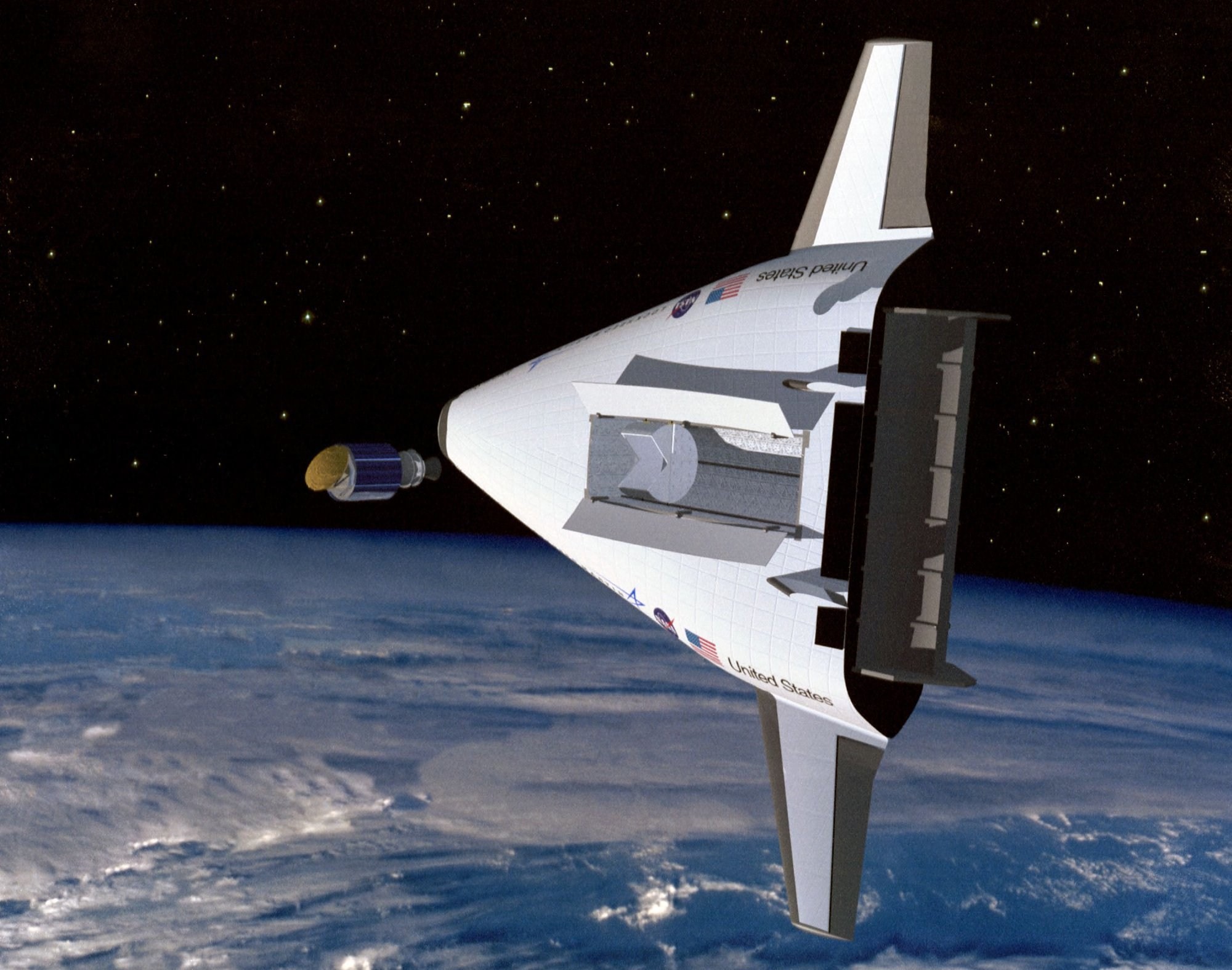
A single-stage-to-orbit (SSTO) vehicle reaches orbit from the surface of a body using only propellants and fluids and without expending tanks, engines, or other major hardware. The term usually, but not exclusively, refers to reusable vehicles. To date, no Earth-launched SSTO launch vehicles have ever been flown; orbital launches from Earth have been performed by multi-stage rockets, either fully or partially expendable.
The main projected advantage of the SSTO concept is elimination of the hardware replacement inherent in expendable launch systems. However, the non-recurring costs associated with design, development, research and engineering (DDR&E) of reusable SSTO systems are much higher than expendable systems due to the substantial technical challenges of SSTO, assuming that those technical issues can in fact be solved. SSTO vehicles may also require a significantly higher degree of regular maintenance.
It is considered to be marginally possible to launch a single-stage-to-orbit chemically fueled spacecraft from Earth. The principal complicating factors for SSTO from Earth are: high orbital velocity of over 7,400 metres per second (27,000 km/h; 17,000 mph); the need to overcome Earth's gravity, especially in the early stages of flight; and flight within Earth's atmosphere, which limits speed in the early stages of flight due to drag, and influences engine performance.
Advances in rocketry in the 21st century have resulted in a substantial fall in the cost to launch a kilogram of payload to either low Earth orbit or the International Space Station, reducing the main projected advantage of the SSTO concept.
Notable single stage to orbit concepts include Skylon, which used the hybrid-cycle SABRE engine that can use oxygen from the atmosphere when it is at low altitude, and then use onboard liquid oxygen after switching to the closed cycle rocket engine at high altitude, the McDonnell Douglas DC-X, the Lockheed Martin X-33 and VentureStar which was intended to replace the Space Shuttle, and the Roton SSTO, a helicopter-like vehicle. However, despite showing some promise, none of them have come close to achieving orbit yet due to problems with finding a sufficiently efficient propulsion system and discontinued development.
Single-stage-to-orbit is much easier to achieve on extraterrestrial bodies that have weaker gravitational fields and lower atmospheric pressure than Earth, such as the Moon and Mars, and has been achieved from the Moon by the Apollo program's Lunar Module, by several robotic spacecraft of the Soviet Luna program, and by China's Chang'e 5 and Chang'e 6 lunar sample return missions.
== History ==
=== Early concepts ===
Before the second half of the twentieth century, very little research was conducted into space travel. During the 1960s, some of the first concept designs for this kind of craft began to emerge.
One of the earliest SSTO concepts was the expendable One stage Orbital Space Truck (OOST) proposed by Philip Bono, an engineer for Douglas Aircraft Company. A reusable version named ROOST was also proposed.
Another early SSTO concept was a reusable launch vehicle named NEXUS which was proposed by Krafft Arnold Ehricke in the early 1960s. It was one of the largest spacecraft ever conceptualized with a diameter of over 50 metres and the capability to lift up to 2000 short tons into Earth orbit, intended for missions to further out locations in the Solar System such as Mars.
The North American Air Augmented VTOVL from 1963 was a similarly large craft which would have used ramjets to decrease the liftoff mass of the vehicle by removing the need for large amounts of liquid oxygen while traveling through the atmosphere.
From 1965, Robert Salkeld investigated various single stage to orbit winged spaceplane concepts. He proposed a vehicle which would burn hydrocarbon fuel while in the atmosphere and then switch to hydrogen fuel for increasing efficiency once in space.
Further examples of Bono's early concepts (prior to the 1990s) which were never constructed include:
ROMBUS (Reusable Orbital Module, Booster, and Utility Shuttle), another design from Philip Bono. This was not technically single stage since it dropped some of its initial hydrogen tanks, but it came very close.
Ithacus, an adapted ROMBUS concept which was designed to carry soldiers and military equipment to other continents via a sub-orbital trajectory.
Pegasus, another adapted ROMBUS concept designed to carry passengers and payloads long distances in short amounts of time via space.
Douglas SASSTO, a 1967 launch vehicle concept.
Hyperion, yet another Philip Bono concept which used a sled to build up speed before liftoff to save on the amount of fuel which had to be lifted into the air.
Star-raker: In 1979, Rockwell International unveiled a concept for a 100-ton payload heavy-lift multicycle airbreather ramjet/cryogenic rocket engine, horizontal takeoff/horizontal landing single-stage-to-orbit spaceplane named Star-Raker, designed to launch heavy Space-based solar power satellites into a 300 nautical mile Earth orbit. Star-raker would have had 3 x LOX/LH2 rocket engines (based on the SSME) + 10 x turboramjets.
Around 1985 the NASP project was intended to launch a scramjet vehicle into orbit, but funding was stopped and the project cancelled. At around the same time, the HOTOL tried to use precooled jet engine technology, but failed to show significant advantages over rocket technology.
=== DC-X technology ===
The DC-X, short for Delta Clipper Experimental, was an uncrewed one-third scale vertical takeoff and landing demonstrator for a proposed SSTO. It is one of only a few prototype SSTO vehicles ever built. Several other prototypes were intended, including the DC-X2 (a half-scale prototype) and the DC-Y, a full-scale vehicle which would be capable of single stage insertion into orbit. Neither of these were built, but the project was taken over by NASA in 1995, and they built the DC-XA, an upgraded one-third scale prototype. This vehicle was lost when it landed with only three of its four landing pads deployed, which caused it to tip over on its side and explode. The project has not been continued since.
=== Roton ===
From 1999 to 2001 Rotary Rocket attempted to build a SSTO vehicle called the Roton. It received a large amount of media attention and a working sub-scale prototype was completed, but the design was largely impractical.
== Approaches ==
There have been various approaches to SSTO vehicles including: pure rockets that are launched and land vertically, air-breathing scramjet-powered vehicles that are launched and land horizontally, nuclear-powered vehicles, and even jet-engine-powered vehicles that can fly into orbit and return landing like an airliner, completely intact.
For rocket-powered SSTO, the main challenge is achieving a high enough mass-ratio to carry sufficient propellant to achieve orbit, plus a meaningful payload weight. One possibility is to give the rocket an initial speed with a space gun, as planned in the Quicklaunch project.
For air-breathing SSTO, the main challenges are system complexity and associated research and development costs, material science, construction techniques necessary for surviving sustained high-speed flight within the atmosphere, and achieving a high enough mass-ratio to carry sufficient propellant to achieve orbit, plus a meaningful payload weight. Air-breathing designs typically fly at supersonic or hypersonic speeds and usually include a rocket engine for the final burn for orbit.
Whether rocket-powered or air-breathing, a reusable vehicle must be rugged enough to survive multiple round trips into space without adding excessive weight or maintenance. In addition, a reusable vehicle must be able to reenter without damage and land safely.
While single-stage rockets were once thought to be beyond reach, advances in materials technology and construction techniques have shown them to be possible. For example, calculations show that the Titan II first stage, launched on its own, would have a 25-to-1 ratio of fuel to vehicle hardware.
It has a sufficiently efficient engine to achieve orbit, but without carrying much payload.
=== Dense versus hydrogen fuels ===
Hydrogen fuel might seem the obvious fuel for SSTO vehicles. When burned with oxygen, hydrogen gives the highest specific impulse of any commonly used fuel: around 450 seconds, compared with up to 350 seconds for kerosene.
Hydrogen has the following advantages:
Hydrogen has nearly 30% higher specific impulse (about 450 seconds vs. 350 seconds) than most dense fuels.
Hydrogen is an excellent coolant.
The gross mass of hydrogen stages is lower than dense-fuelled stages for the same payload.
Hydrogen is environmentally friendly.
However, hydrogen also has these disadvantages:
Very low density (about 1⁄7 of the density of kerosene) – requiring a very large tank
Deeply cryogenic – must be stored at very low temperatures and thus needs heavy insulation
Escapes very easily from the smallest gap
Wide combustible range – easily ignited and burns with a dangerously invisible flame
Tends to condense oxygen which can cause flammability problems
Has a large coefficient of expansion for even small heat leaks.
These issues can be dealt with, but at extra cost.
While kerosene tanks can be 1% of the weight of their contents, hydrogen tanks often must weigh 10% of their contents. This is because of both the low density and the additional insulation required to minimize boiloff (a problem which does not occur with kerosene and many other fuels). The low density of hydrogen further affects the design of the rest of the vehicle: pumps and pipework need to be much larger in order to pump the fuel to the engine. The result is the thrust/weight ratio of hydrogen-fueled engines is 30–50% lower than comparable engines using denser fuels.
This inefficiency indirectly affects gravity losses as well; the vehicle has to hold itself up on roc
📊
Mapa Powiązań
Neural_Network // Co-Mentioned_Entities
📰
Najnowsze Wzmianki
Live_Feed // 1 artykułów
>_ Rombus Defense Systems
Firma // Entity_Profile
[DATA] A single-stage-to-orbit (SSTO) vehicle reaches orbit from the surface of a body using only propellants and fluids and without expending tanks, engines, or other major hardware. The term usually, but not exclusively, refers to reusable vehicles. To date, no Earth-launched SSTO launch vehicles have ever been flown; orbital launches from Earth have been performed by multi-stage rockets, either fully
[METRICS] Encja posiada 1 wzmianek w bazie oraz 1 powiązanych artykułów. Trust Score: 50/100.
Wersja statyczna dla wyszukiwarek. Pełna wersja interaktywna z grafiką dostępna po włączeniu JavaScript.