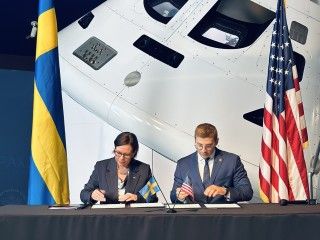
Pax Silica is a United States-led international initiative focused on strengthening and coordinating "trusted" supply chains for advanced technologies—especially semiconductors, artificial intelligence (AI) infrastructure, critical minerals, advanced manufacturing, logistics, and associated energy and data infrastructure. The initiative is coordinated by the US Department of State and was launched in December 2025 alongside the signing of the non-binding Pax Silica Declaration by an initial group of partner countries.
The initiative describes itself as a "positive-sum" partnership intended to reduce "coercive dependencies" and improve resilience across the full technology stack, from mineral extraction and processing through chip manufacturing and computing infrastructure.
== Background ==
During the 2020s, governments increasingly treated supply-chain resilience in semiconductors, critical minerals, and AI-related computing infrastructure as a national-security priority, amid export controls, industrial policy measures, and geopolitical competition over the technologies underpinning advanced manufacturing and AI. Pax Silica was presented by US officials as an economic-security framework aimed at aligning policies and investment among "trusted partners" that host major technology firms and key industrial capacity. Pacific Forum's analyst Akhil Ramesh, writing for the National Interest magazine, described the initiative as understanding that: "economic security today is inseparable from control over energy, critical minerals, high-end manufacturing, and advanced models."
== US announcement and launch ==
On December 11, 2025, the US Department of State announced the inaugural Pax Silica Summit and a planned signing of the Pax Silica Declaration, describing Pax Silica as the Department's flagship effort on AI and supply-chain security.
The initial summit was held in Washington, D.C. on December 12, 2025. The State Department fact sheet described cooperation areas including connectivity and data infrastructure, compute and semiconductors, advanced manufacturing, logistics, mineral refining and processing, and energy.
== Membership ==
Pax Silica participation has been discussed in terms of (1) countries that have signed the declaration and (2) countries invited to summit discussions or publicly reported as prospective signatories but which had not (as of mid-January 2026) signed the declaration.
=== Countries that signed the Pax Silica Declaration ===
Seven countries signed the declaration at the December 12, 2025, summit in Washington, D.C. Some countries who attended the initial conversations did not immediately sign, while additional countries were invited to join after the discussions concluded. The following are the current signatory countries on the declaration:
United States
Greece
Australia
Japan
South Korea
United Kingdom
Singapore
Israel
Netherlands (joined December 17, 2025; "non-signing partner")
Qatar (joined January 13, 2026)
United Arab Emirates (joined January 14, 2026)
India (joined February 20, 2026)
Sweden (joined March 17, 2026)
=== Countries invited / participating, but not yet signed ===
At launch, US materials and contemporaneous reporting described additional invited participants and observers, including:
Canada – observer/participant in related discussions, per US briefing materials; not listed among signatories.
Taiwan – participated in summit sessions according to a State Department briefing; not listed among signatories.
The Organisation for Economic Co-operation and Development (OECD) and European Union were also noted by US officials as present in an observer capacity, but are not countries.
== Activities and proposed projects ==
US officials described Pax Silica as a framework for coordinating flagship projects and policy alignment across partner countries, including supply-chain mapping, investment and co-investment initiatives, and protection of critical infrastructure and sensitive technologies. Reuters reported discussions of projects linked to trade and logistics routes and an industrial park initiative in Israel. Gulf countries, such as the UAE and Qatar, are betting on attracting AI companies with cheap energy. Moreover, the UAE's potential to invest in Pax Silica's activities has been noted as a fundamental asset for the initiative.
== See also ==
Critical minerals
CHIPS and Science Act (United States)
Economic security
== References ==
== External links ==
Full text of Pax Silica at the State Department website
📊
Mapa Powiązań
Neural_Network // Co-Mentioned_Entities
📰
Najnowsze Wzmianki
Live_Feed // 1 artykułów
>_ Pax Silica
Organizacja // Entity_Profile
[DATA] Pax Silica is a United States-led international initiative focused on strengthening and coordinating "trusted" supply chains for advanced technologies—especially semiconductors, artificial intelligence (AI) infrastructure, critical minerals, advanced manufacturing, logistics, and associated energy and data infrastructure. The initiative is coordinated by the US Department of State and was launched
[METRICS] Encja posiada 1 wzmianek w bazie oraz 1 powiązanych artykułów. Trust Score: 50/100.
Wersja statyczna dla wyszukiwarek. Pełna wersja interaktywna z grafiką dostępna po włączeniu JavaScript.