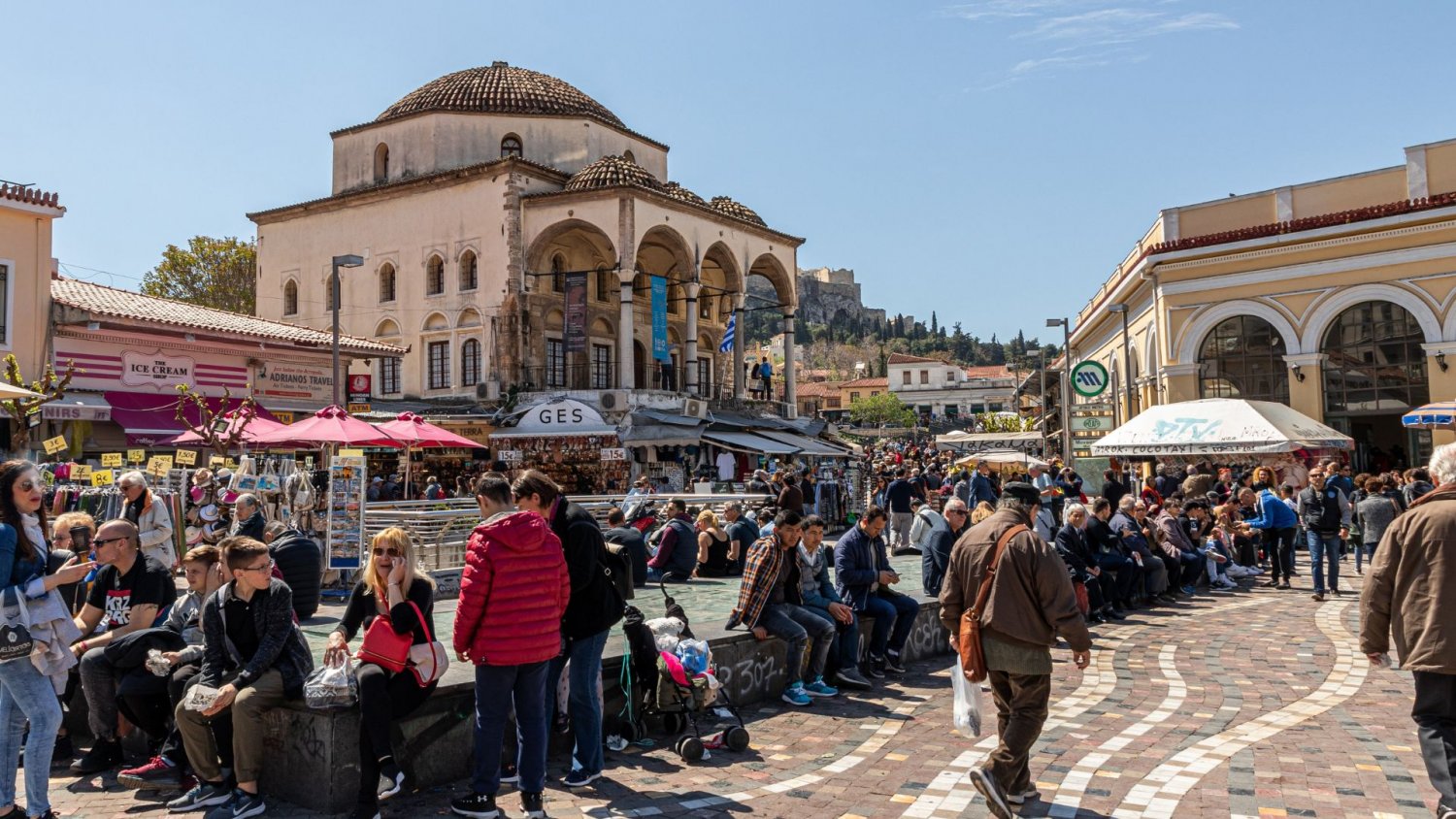
Athens is the capital and largest city of Greece. A significant coastal urban area in the Mediterranean, Athens is also the capital of the Attica region and is the southernmost capital on the European mainland. With its urban area's population numbering over 3.6 million, it is the eighth-largest urban area in the European Union (EU). The Municipality of Athens (also City of Athens), which constitutes a small administrative unit of the entire urban area, had a population of 643,452 in 2021, within its official limits, and a land area of 38.96 square kilometres (15.04 square miles).
Athens is one of the world's oldest cities, with its recorded history spanning over 3,400 years, and its earliest human presence beginning somewhere between the 11th and 7th millennia BC. According to Greek mythology, the city was named after Athena, the ancient Greek goddess of wisdom, but modern scholars generally agree that the goddess took her name after the city. Classical Athens was one of the most powerful city-states in ancient Greece. It was a centre for Ancient Greek democracy, the arts, education and philosophy, and was highly influential throughout the Hellenistic world and the European continent, particularly in Ancient Rome. For this reason it is often regarded as the cradle of Western civilisation and the birthplace of democracy in its own right independently from the rest of Greece.
In modern times Athens is a large cosmopolitan metropolis and central to economic, financial, industrial, maritime, political and cultural life in Greece. It is a Beta (+) –
status global city according to the Globalization and World Cities Research Network, and is one of the biggest economic centres in Southeast Europe. It also has a large financial sector, and its port Piraeus is both the second-busiest passenger port in Europe and the thirteenth-largest container port in the world. The Athens metropolitan area extends beyond its administrative municipal city limits as well as its urban agglomeration, with a population of 3,638,281 in 2021 over an area of 2,928.717 km2 (1,131 sq mi).
The heritage of the Classical Era is still evident in the city, represented by ancient monuments, and works of art, the most famous of these being the Parthenon, considered a key landmark of early Western culture. Athens retains Roman, Byzantine and a smaller number of Ottoman monuments, while its historical urban core features elements of continuity through its millennia of history. Athens contains two World Heritage Sites recognised by UNESCO: the Acropolis of Athens and the medieval Daphni Monastery. Athens is home to several museums and cultural institutions, such as the National Archeological Museum, featuring the world's largest collection of ancient Greek antiquities, the Acropolis Museum, the Museum of Cycladic Art, the Benaki Museum and the Byzantine and Christian Museum. Athens was the host city of the first modern-day Olympic Games in 1896, and 108 years later it hosted the 2004 Summer Olympics, making it one of five cities to have hosted the Summer Olympics on more than one occasion.
== Etymology and names ==
In Ancient Greek, the city's name was Ἀθῆναι (Athênai, pronounced [atʰɛ̂ːnai̯] in Classical Attic), which is a plural word. In earlier Greek, such as Homeric Greek, the name had been current in the singular form though, as Ἀθήνη (Athḗnē). It was possibly rendered in the plural later on, like those of Θῆβαι (Thêbai) and Μυκῆναι (Μukênai). The root of the word is probably not of Greek or Indo-European origin, and is possibly a remnant of the Pre-Greek substrate of Attica.
In classical antiquity it was debated whether Athens took its name from its patron goddess Athena (Attic Ἀθηνᾶ, Athēnâ, Ionic Ἀθήνη, Athḗnē, and Doric Ἀθάνα, Athā́nā) or Athena took her name from the city. Modern scholars now generally agree that the goddess takes her name from the city, because the ending -ene is common in names of locations, but rare for personal names.
According to the ancient Athenian founding myth, Athena, the goddess of wisdom and war, competed against Poseidon, the God of the Seas, for patronage of the yet-unnamed city; they agreed that whoever gave the Athenians the better gift would become their patron and appointed Cecrops, the king of Athens, as the judge. According to the account given by Pseudo-Apollodorus, Poseidon struck the ground with his trident and a salt water spring welled up. In an alternative version of the myth from Virgil's poem Georgics, Poseidon instead gave the Athenians the first horse. In both versions, Athena offered the Athenians the first domesticated olive tree.
Cecrops accepted this gift and declared Athena the patron goddess of Athens. Eight different etymologies, now commonly rejected, have been proposed since the 17th century. Christian Lobeck proposed as the root of the name the word ἄθος (áthos) or ἄνθος (ánthos) meaning "flower", to denote Athens as the "flowering city". Ludwig von Döderlein proposed the stem of the verb θάω, stem θη- (tháō, thē-, "to suck") to denote Athens as having fertile soil.
Athenians were called cicada-wearers (Ancient Greek: Τεττιγοφόροι) because they used to wear pins of golden cicadas. A symbol of being autochthonous (earth-born), because the legendary founder of Athens, Erechtheus was an autochthon or of being musicians, because the cicada is a "musician" insect. In classical literature the city was sometimes referred to as the City of the Violet Crown, first documented in Pindar's ἰοστέφανοι Ἀθᾶναι (iostéphanoi Athânai), or as τὸ κλεινὸν ἄστυ (tò kleinòn ásty, "the glorious city").
During the medieval period, the name of the city was rendered once again in the singular as Ἀθήνα. Variant names included Setines, Satine, and Astines, all derivations involving false splitting of prepositional phrases. King Alphonse X of Castile credits Ovid with the false etymology 'the place without death' because of Athens' arts and sciences "that never die". In Ottoman Turkish, it was called آتينا Ātīnā.
== History ==
=== Antiquity ===
The oldest known human presence in Athens is the Cave of Schist, which has been dated to between the 11th and 7th millennia BC. Athens has been continuously inhabited for at least 5,000 years (3000 BC). By 1400 BC, the settlement had become an important centre of the Mycenaean civilisation, and the Acropolis was the site of a major Mycenaean fortress, whose remains can be recognised from sections of the characteristic Cyclopean walls. Unlike other Mycenaean centres, such as Mycenae and Pylos, it is not known whether Athens suffered destruction in about 1200 BC, an event often attributed to a Dorian invasion, and the Athenians always maintained that they were pure Ionians with no Dorian element. However, Athens, like many other Bronze Age settlements, went into economic decline for around 150 years afterwards. Iron Age burials, in the Kerameikos and other locations, are often richly provided for and demonstrate that from 900 BC onwards Athens was one of the leading centres of trade and prosperity in the region.
=== Classical Athens ===
By the sixth century BC, widespread social unrest led to the reforms of Solon. These would pave the way for the eventual introduction of democracy by Cleisthenes in 508 BC. Athens had by this time become a significant naval power with a large fleet, and helped the rebellion of the Ionian cities against Persian rule. In the ensuing Greco-Persian Wars Athens, together with Sparta, led the coalition of Greek states that would eventually repel the Persians, defeating them decisively at Marathon under the leadership of Miltiades in 490 BC, and crucially at Salamis under the leadership of Themistocles in 480 BC. However, this did not prevent Athens from being captured and sacked twice by the Persians within one year, after a heroic but ultimately failed resistance at Thermopylae by Spartans and other Greeks led by King Leonidas, after both Boeotia and Attica fell to the Persians.
The decades that followed became known as the Golden Age of Athenian democracy, during which time Athens became the leading city of Ancient Greece, with its cultural achievements laying the foundations for Western civilisation. The playwrights Aeschylus, Sophocles and Euripides flourished in Athens during this time, as did the historians Herodotus and Thucydides, the physician Hippocrates, and the philosophers Socrates and Plato. Guided by Pericles, who promoted the arts and fostered democracy, Athens embarked on an ambitious building program that saw the construction of the Acropolis of Athens (including the Parthenon), as well as empire-building via the Delian League. Originally intended as an association of Greek city-states, which were led by Cimon, to continue the fight against the Persians, the league soon turned into a vehicle for Athens's own imperial ambitions. The resulting tensions brought about the Peloponnesian War (431–404 BC), in which Athens was defeated by its rival Sparta.
Nonetheless the city reemerged soon as a major power in the Greek world, forming the Second Athenian League during the time of the Spartan and Theban hegemonies. By the mid-4th century BC the northern Greek kingdom of Macedon was becoming dominant in Greek affairs. In 338 BC the armies of Philip II and his son Alexander the Great defeated an alliance of some of the Greek city-states led by Athens and Thebes at the Battle of Chaeronea. After this defeat, Athens joined the Hellenic League under Philip and then Alexander.
=== Roman Empire ===
Later, under Rome, Athens was given the status of a free city because of its widely admired schools. In the second century AD, the Roman emperor Hadrian, himself an Athenian citizen, ordered the construction of a number of public buildings. Paul the Apostle visited Athens on his second missionary journey. Athens was sacked in 267 AD by a Germanic tribe.
In the early 4th century AD the Eastern Roman Empire began to be governed from Con
📊
Mapa Powiązań
Neural_Network // Co-Mentioned_Entities
📰
Najnowsze Wzmianki
Live_Feed // 1 artykułów
>_ Charis Doukas
Osoba // Entity_Profile
[DATA] Athens is the capital and largest city of Greece. A significant coastal urban area in the Mediterranean, Athens is also the capital of the Attica region and is the southernmost capital on the European mainland. With its urban area's population numbering over 3.6 million, it is the eighth-largest urban area in the European Union (EU). The Municipality of Athens (also City of Athens), which constitu
[METRICS] Encja posiada 1 wzmianek w bazie oraz 1 powiązanych artykułów. Trust Score: 50/100.
Wersja statyczna dla wyszukiwarek. Pełna wersja interaktywna z grafiką dostępna po włączeniu JavaScript.